Mold inspection and testing in Cary, NC
A mold inspection answers three questions: is there mold, what moisture is feeding it, and how far has it spread. Testing adds lab evidence when the answer is not visible.
- Visual inspection with moisture meters and thermal imaging
- Indoor air samples with an outdoor comparison
- Swab or tape samples of suspect growth
- Analysis by an accredited lab
- Written report with photos and next steps
Covering Cary · Apex · Holly Springs · Morrisville · Raleigh
Request mold inspection and testing
Moisture mapped, not guessed
Moisture meters and thermal imaging trace how far the water traveled, so drying and tear-out stop where the damage stops.
Mold sealed off first
Moldy areas are closed in with plastic and kept under negative air with HEPA filters, so spores stay out of the rest of the house.
Paperwork insurers expect
Photos, daily moisture logs and an itemized estimate, so a claim has the documentation adjusters ask for.
Why choose us
Dry, clean and documented
A leak becomes a mold problem when the house is not dried in time. Quick extraction, measured drying and proper containment keep one bad day from turning into months of repairs.
- Fast response to active leaks
- Moisture readings every visit
- Containment and HEPA filtration
- Photos and logs for insurance
- Written, itemized estimates
- Local to Cary
When a mold inspection makes sense
An inspection is worth it when something tells you there is a problem but you cannot see it:
- A musty smell with no visible source, especially one that gets worse when the air conditioning runs.
- A past leak, flood or overflow that may not have been dried properly.
- Stains, peeling paint or soft drywall that suggest water inside a wall.
- Allergy or asthma symptoms that improve when you are away from the house.
- Buying a house, particularly one that sat empty or shows signs of old water damage.
- After remediation, to confirm the work before walls are closed.
When testing is not needed
If you can see mold, you already know the answer to the first question. EPA guidance is that sampling is usually unnecessary when mold is visible: it needs to be removed whatever the species, and the moisture problem fixed. The money is usually better spent finding the moisture and measuring how far it reached. There are also no federal limits for mold in homes, so a number on a lab report only means something in context.
What happens during an inspection
A good inspection starts with questions: past leaks, roof repairs, plumbing work, when the smell started and where it is strongest. Then the inspector works through the house, inside and out:
- Exterior: gutters, grading, roof flashing, windows and siding where water gets in.
- Moisture meters on walls, floors, ceilings and cabinets, especially below bathrooms and around windows.
- Thermal imaging, which shows temperature differences that often mean moisture, confirmed with a meter because a cold spot is not always a wet one.
- Humidity readings in each area of the house.
- The attic, crawl space and HVAC system, including the air handler, drain pan and duct connections.
- A borescope, a small camera passed through a tiny hole, where a wall cavity needs a look.
Air sampling
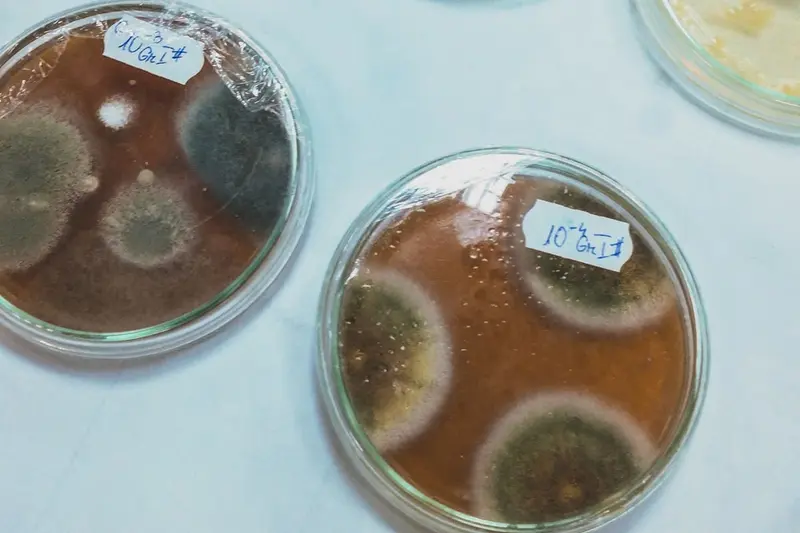
Air samples are collected by drawing a measured volume of air through a cassette that traps spores. One sample is taken outdoors as a baseline and others in the rooms of concern. The lab counts and identifies the spores under a microscope. Indoor counts well above the outdoor sample, or indoor types that are scarce outside, such as Stachybotrys or Chaetomium, point to growth inside the house. Air samples are a snapshot, affected by weather, activity and recent cleaning, so they are read alongside everything the inspection found.
Surface sampling
A tape lift or swab from a suspect stain tells whether it is mold, and which kinds, or just dirt, soot or staining. Surface samples are useful for settling a question about a specific spot, such as a discolored ceiling or dark marks around an air vent.
The lab and the report
Samples should go to a laboratory accredited for environmental microbiology, such as one in the AIHA Laboratory Accreditation Programs. The report you receive should include photos, moisture readings, the lab results with a plain-language explanation, the likely moisture source and a recommended scope of work. If remediation is needed, that scope becomes the plan for mold remediation.
Mold inspections when buying or selling
In a North Carolina home sale, most inspections happen during the buyer’s due diligence period, when the clock is short. A general home inspector notes visible staining or “microbial growth” but usually does not sample it or trace the moisture. A mold inspection fills that gap: it confirms what the stain is, finds the source and gives you a scope you can price before the period ends. Sellers who suspect a problem, such as an old leak or an attic with stained sheathing, can have it inspected before listing and fix it on their own schedule instead of under a buyer’s deadline.
Inspection after remediation
Post-remediation verification closes the loop. Before the containment comes down, the area is checked visually, measured for moisture and often sampled. Passing means the area is back to normal levels, and it gives you documentation for a future buyer. If the musty smell was what started it, the smell should be gone too.
Mold inspection and testing — common questions
Are home mold test kits reliable?
Not very. Settle plates left open on a counter grow mold in almost any house, because spores are always present indoors. Without a measured air volume and an outdoor comparison, the result says little about whether there is a problem.
How long do mold test results take?
Labs commonly report air and surface samples within one to three business days, and faster turnaround is usually available for an added fee.
Should the inspector also do the remediation?
Many homeowners prefer an independent inspector, so the person recommending the work does not profit from it. Some states require that separation; North Carolina does not, so it is your call.
What is post-remediation verification?
A check after mold removal, ideally by someone independent: a visual inspection, moisture readings and often air samples, to confirm the area is back to normal before it is rebuilt.
Is there a safe level of mold?
There are no federal standards for mold in homes. Results are judged by comparing indoor samples with outdoor air and with other rooms, and by the types of mold found.
Problems this fixes
Often booked with this